
News
Search
-
Find By Category
- Admissions (13)
- Air Force ROTC (3)
- Alumni (90)
- Army ROTC (5)
- Athletics (38)
- Awards and Rankings (130)
- Biology (21)
- Business (45)
- Campus Ministry (11)
- Campus Safety (11)
- Chemistry (12)
- College of Arts & Sciences (48)
- Commencement (23)
- Communication Studies (23)
- Development (31)
- Dundon-Berchtold Institute (8)
- Education (19)
- Engineering (86)
- English (6)
- Environmental Studies (10)
- Franz Center (18)
- Garaventa Center (14)
- Health Center (9)
- History (6)
- Honors Program (0)
- Human Resources (5)
- International Languages & Cultures (10)
- International Student Services (2)
- Library (7)
- Mathematics (13)
- Moreau Center (8)
- Nursing (50)
- Performing & Fine Arts (19)
- Philosophy (3)
- Physics (6)
- Pilots Prevent (113)
- Political Science (5)
- Portland Magazine (221)
- President (65)
- Psychology (3)
- Recreational Services (6)
- Residence Life (21)
- Shepard Academic Resource Center (4)
- Social Media (14)
- Social Work (4)
- Sociology (5)
- Student Activities (7)
- Student Affairs (4)
- Study Abroad (7)
- Theology (7)
- Undergraduate Scholarly Engagement (19)
-
Find By Date
- 2026
- 2025
- 2024
- 2023
- 2022
- 2021
- 2020
- 2019
- 2018
- 2017
- 2016
- 2015
Shiley School of Engineering partners with Tektronix on geolocation project
Engineering
April 25, 2018
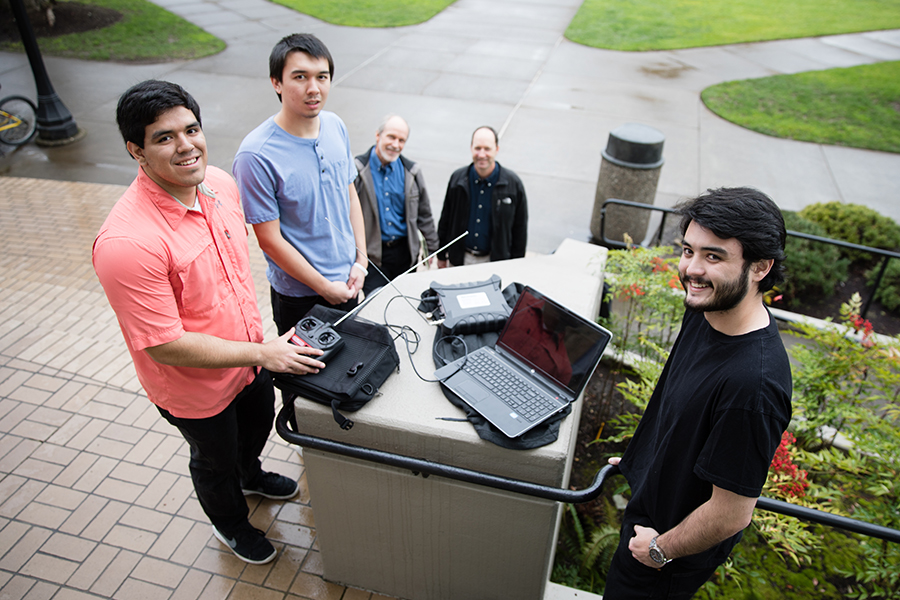
Three electrical engineering students have teamed with Tektronix for their senior design project. With guidance from Tektronix principal engineer Kyle Bernard ’85 and electrical engineering professor Joe Ho beck, the team is working to locate a transmitter near the University’s campus using Tektronix RSA500 devices.
“I have learned so much about project management by working with Tektronix,” Jacob Buckley ’18 said. “This project has taught me how to learn on the y, which is important for my future career in the industry.”
Buckley, Sean Endo ’18, and George Porras ’18 are recording the transmitter’s signals and processing those recordings to estimate the transmitter’s location using software they wrote. They will soon begin field testing and system tuning. The students’ work on this geolocation project could help further other projects in locating rogue transmitters that are causing interference, such as GPS, cell phones, and satellites.
“This project is challenging because the students have not encountered something like this in their coursework,” Ho beck said. “Being able to design a system to meet a given goal is an important part of what engineers do professionally.”
Bernard, who has worked at Tektronix for 38 years, has enjoyed working with the students, who have now learned the operation of the Tektronix RSA500 devices and prototyped the system. “Working closely with engineers in the industry expands students’ experience beyond theory,” Bernard said. “Projects like this expose engineering students to the practices of modern engineering and development.”
