December 2025
The Stories that Bind Us
How a political science professor uses stories to show our connectedness.
- Story by Anne Santiago
The Catholic intellectual tradition offers many ways to support students and equip them with tools to examine the present moment. UP political science professor Anne Santiago, who contributed an essay to the collection pictured on the right, uses the traditions of the “sacramental and prophetic imagination” as a lens for an assignment she gives to her Perspectives on Social Justice students.
The tradition of the “prophetic imagination” sees the world’s suffering in pointed terms and responds to it through action (and sometimes righteous anger)—Catholic Social Teaching goes hand in hand with this lens. At the same time, the “sacramental imagination,” Santiago writes, “recognizes that beauty, grace, and wonder are always available to us in all aspects of life because God is present in all things.”
Santiago aims to engage both types of imagination in her classes by focusing on human stories. What follows is an excerpt of her essay in the collection.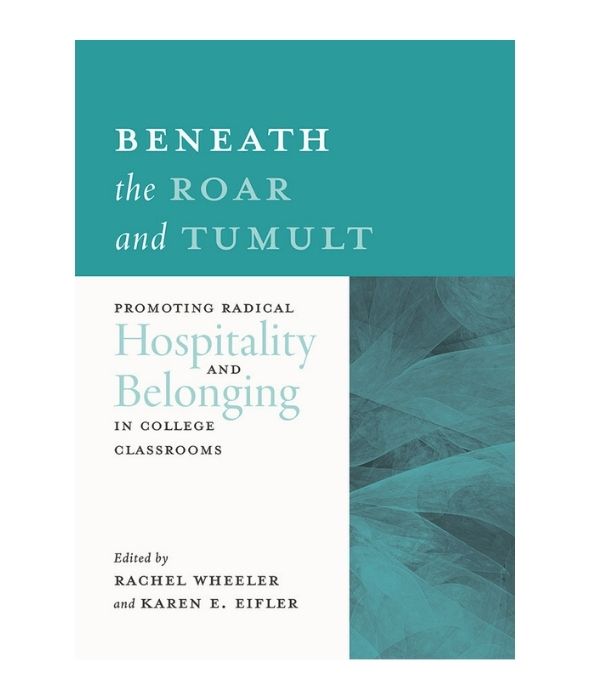
In his book, Between the Listening and the Telling: How Stories Can Save Us, Mark Yaconelli asserts that storytelling is the key to understanding “the other.” He writes, “[T]he honest listening and telling of personal experiences naturally endears us to one another. The illusion of separateness dissipates, and we see ourselves in one another’s story. When that happens, we are no longer able to demonize, ridicule, oppress, or neglect the other.” Early in the semester, students choose a memoir of any author who does not share their dominant identities and then write a reflective essay. Part of the assignment’s prompt reads: “The purpose of the book review is to try to understand the experiences and ideas that shaped the author. Think about what the author has to say about issues of social justice within the context of their personal stories. How does their worldview align with or diverge from your own ideas?” This assignment seeks to cultivate understanding of “the other” and to recognize that humans are graced, even as we experience hardship and injustice.
Before students choose their books, we view a TED talk by author Chimamanda Ngozi Adichie. Adichie expertly relays that anytime we think we understand “the other” because we have read something by them, know something about their experience or identities, or have a positive or negative encounter with them, we should step back and recognize that each individual is a complex, multifaceted person who is more than the sum of her parts. None of us is understood through a single story. In asking students to read and reflect on another’s story, they must recognize that they are encountering a mere snippet of another person’s life. Such an encounter demands humility.
Yaconelli’s belief in the power of stories reflects the prophetic and sacramental imaginations. There is beauty and grace in vulnerably sharing stories of our struggles. Yaconelli asserts, “Every life holds beauty. Every life encounters suffering. Every life is a struggle to claim dignity and worth. And each of us has lived a story worth telling.” One student insightfully reflected, “In an academic setting, conversations based around theory can easily become speculatory and lack human grounding, especially when the topic is rooted in lived experiences that are inaccessible to those having the discussion.” Through these encounters [with story] we develop empathy and understanding.
After graduating, Rick, a former student in the Perspectives on Social Justice course, worked as a volunteer intake coordinator at an immigrant rights organization. In a newsletter article, Rick affirmed what Yaconelli asserts: storytelling is important because it brings one into solidarity with others. He states, “We record the stories of those who need a voice, because the world can be extremely unfair, and we believe that everyone, especially the most vulnerable, should have the chance to live a secure and dignified life.”
Students experience the prophetic dimension through stories of those who have struggled because of their marginalized identities. The approach demands that students ponder their own place in the world and sit in solidarity with the storyteller. Yet, Yaconelli poignantly asserts, “Stories are designed to move us, to inspire us to act.” The assignment propels students along the path of discernment about where and how to engage in creating a world that is more just. Stories are a powerful tool of encountering the sacramental while inspiring a prophetic call to action.
ANNE SANTIAGO, PhD, is UP’s Dundon-Berchtold Faculty Fellow for Constructive Dialogue. She teaches in the Political Science Department.