December 2025
Lost and Found
She has left possessions in several countries and a few oceans. But Japan kept returning things to her.
- Story by Sallie Tisdale
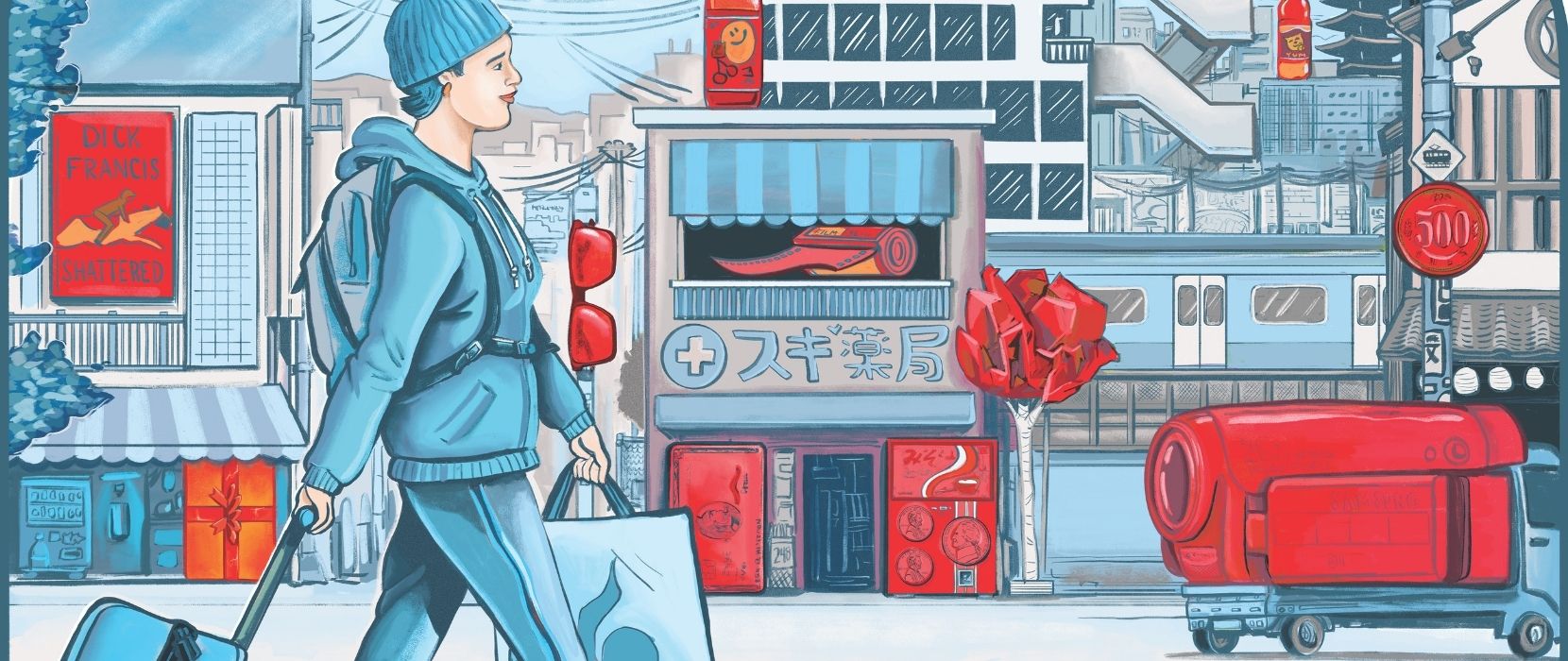
Illustration by Matt Haney
THE FIRST TIME I went to Japan, my friends and I moved quickly from city to city. The trains in Japan are punctual, and we were often rushing to get to the station in time. In our dash for a seat in Kyoto, one of my traveling companions left our video camera on a platform. Someone noticed at once, but by then we were on our way. At the next station, two of us got off and caught the next train back. We stepped onto the platform and there was the camera, exactly where it had been left. It was being guarded by an attendant.
A few days later, I left the same camera on the counter in a pharmacy. Rushing back in distress, I saw a half-dozen people leaning out the pharmacy door, looking up and down the road. One held the camera, and everyone waved to me with delight and relief.
Losing things on the road doesn’t usually work out like this for me. A few years ago, I accidentally left a half-finished mystery under my chair at a deserted gate in the Nassau airport. I returned just a few minutes later, but it was already gone. I found the security office and asked for the lost and found section, and the two men laughed with Bahamian good nature.
“You betta get a new book!” one said, smiling and shaking his head.
I have left possessions in several countries, and a few oceans. I mislaid two pairs of contact lenses and most of my cash in Ireland. My American Express card disappeared into a lagoon on Bonaire. I left my favorite hoodie on the plane heading home from Amsterdam. On the island of Cozumel, I dropped a roll of film into the mouth of a captive crocodile.
In London, I just lost my way.
Japan kept returning things to me. In Tokyo, a woman ran across a busy street to give me a tiny, crumpled note that had fallen out of my purse. In Nara, another woman chased me three blocks on a hot afternoon to return a small coin I had dropped.
A few years after failing to mislay a camcorder, I was traveling in Japan alone. I had finished a good book just before checking out of a hotel. I like to bring used paperback books with me when I travel, so that I can leave them behind when they are finished. I like to think my discarded novels will be welcome finds, gifts to stranded travelers needing distraction. So I left the book on top of the television and, while I was at it, a few American coins in a neat pile. I put a half-empty bottle of tea and an empty juice bottle by the trash can, in case they might be recycled.
I had to run a few errands before leaving town, so I put my bags behind the reception desk. When I picked up my luggage, the clerk signaled me to wait, and he disappeared into his office. He came out carrying my battered Dick Francis in both hands and gave it to me like a jeweler showing a diamond necklace. Then he handed me a nickel, two pennies, a half-empty bottle of tea, and an empty juice bottle.
I still had the book when I got to Osaka. One evening I carried it up and down the dim halls of the small business hotel, and after some time I found myself alone long enough to stash it on top of the soda machine.
When I left the hotel a few days later, the book was still there.


Everyone has woken with a start: Where is it? Where is my gym bag? My tent. My favorite swimsuit. That sudden jolt: I can’t remember where I put it! Memory is as full of holes as a lace doily, and almost as fragile. How can we lose what we prize? And yet we do. My favorite skirt. Almost all my baby pictures. How could I? The entire box of mixtapes. In the Japanese language, if you are lost, you can say, “Michi-ga-wakarimasen.” This literally means, “I do not know the road.” But the verb means more than knowing; it is not a lack of information, but a lack of understanding. To say, “wakarimasen” is to say that you may never be able to find an answer.
I began to think of my lost items as gifts. The Japanese were always pressing small things on me, extra tidbits here and there. I had a small, collapsible umbrella that had been pressed into my hand by a young hotel clerk, over my protests. I thought of leaving it on top of the lockers in the train station, but I had begun to wonder if my sneaky attempts weren’t part of the culture of gift-giving, but instead a form of littering. The JR train system has to handle millions of items lost on the trains every year. Thousands of them are umbrellas.
So I still had the small umbrella toward the end of my trip. I stepped into the path of a young American woman stepping off a train from the airport. There was thunder and lightning in the sky, and bursts of torrential rain.
“You’ll need this,” I assured her. She looked at me with suspicion and tried to turn away. She had just arrived; she didn’t know that this part of the universe was going to keep giving back.
“No, really, it’s for you!” I said, smiling, bowing slightly, pushing it into her hands over her protests and walking quickly away.
Wakarimasen. We never find an answer.
My wisdom teeth. One appendix.
Four dogs, three cats, and a turtle.
My cousin Geoff. My best friend. My favorite teacher.
Both parents.
How are the books balanced? And for all that I couldn’t leave things behind in Japan, I couldn’t find everything I wanted. Often there was no seat for me on a crowded train. I gave up on finding cheese. In Uganda, I couldn’t find a mirror. In rural India, not a cocktail to be found. No eggs for breakfast in the Netherlands. Of all things in Italy, no comfortable shoes that fit. But perhaps the universe barters in secret. I’ve found many books. A nice jacket. More than one umbrella. My friend Amy loses sunglasses wherever she goes, but she finds them, too. Not long after losing a pair, she comes across another pair, and they are just right. It happens every time. Amy trusts sunglasses now, as though they have decided to look out for her.
In a long-forgotten box in the basement, I found my brother’s letters, lost for decades. I found a woman I knew in Guatemala when she walked into a friend’s living room in Portland years later.
In a dusty locked cupboard in the back room of a small rural museum, I found my great-great-great-grandfather’s Bible; I hadn’t known it existed.
On a tiny island in the northern Bahamas, I found a piano on the edge of a coral reef, under forty feet of water. It was slightly battered but upright, and the sun glanced brightly off the white keys.
I found hope.
I lost the my sunglasses in Nara. I had shopped all afternoon, looking for little gifts to bring home with me, and somewhere I had put down my sunglasses. I spent two hours trying to retrace my steps, without luck. For once, something was well and truly gone in Japan.
A few days later in Kyoto, I accidentally left a bag in a toilet stall in the underground mall of the subway. The bag held an irreplaceable book, a gift from a scholar, a book important to my research and one I would have been hard-pressed to replace. I realized it was missing just a few minutes later, and rushed back, but it was gone.
I tried the housekeeper first, but she didn’t have it. I went to the subway information booth next, and then the mall reception desk, and finally was taken through a locked door down a long hallway to a small windowless office, where a young man in a neat white uniform sat at a desk.
I described the book to him with faint despair. I knew the book was gone for good. He smiled and reached into his drawer and pulled out my book. Someone had wrapped it in nice paper with a neat ribbon bow tied on top. A gift.
I waited a few moments in the hope that he had somehow also found my sunglasses. Perhaps my mother? Both lost far away, and one, long ago. But magic seemed at work that day. Alas, he had not. They belong to someone else now, in a country I haven’t visited yet, and I have let them go.
SALLIE TISDALE ’83 is the author of more than 10 books, most recently Survivor and the Endless Gaze.